
News, Software, Technology
America’s Sweatiest Cities Are Feeling the Heat — and Investing to Stay Cool
 Thumbtack reveals its official 2026 list of America’s Sweatiest Cities and the home projects helping homeowners beat the heat.
By: Morgan Olsen, Thumbtack’s Home Design Expert
The summer heat is on, and Americans are working harder than ever to keep their cool.
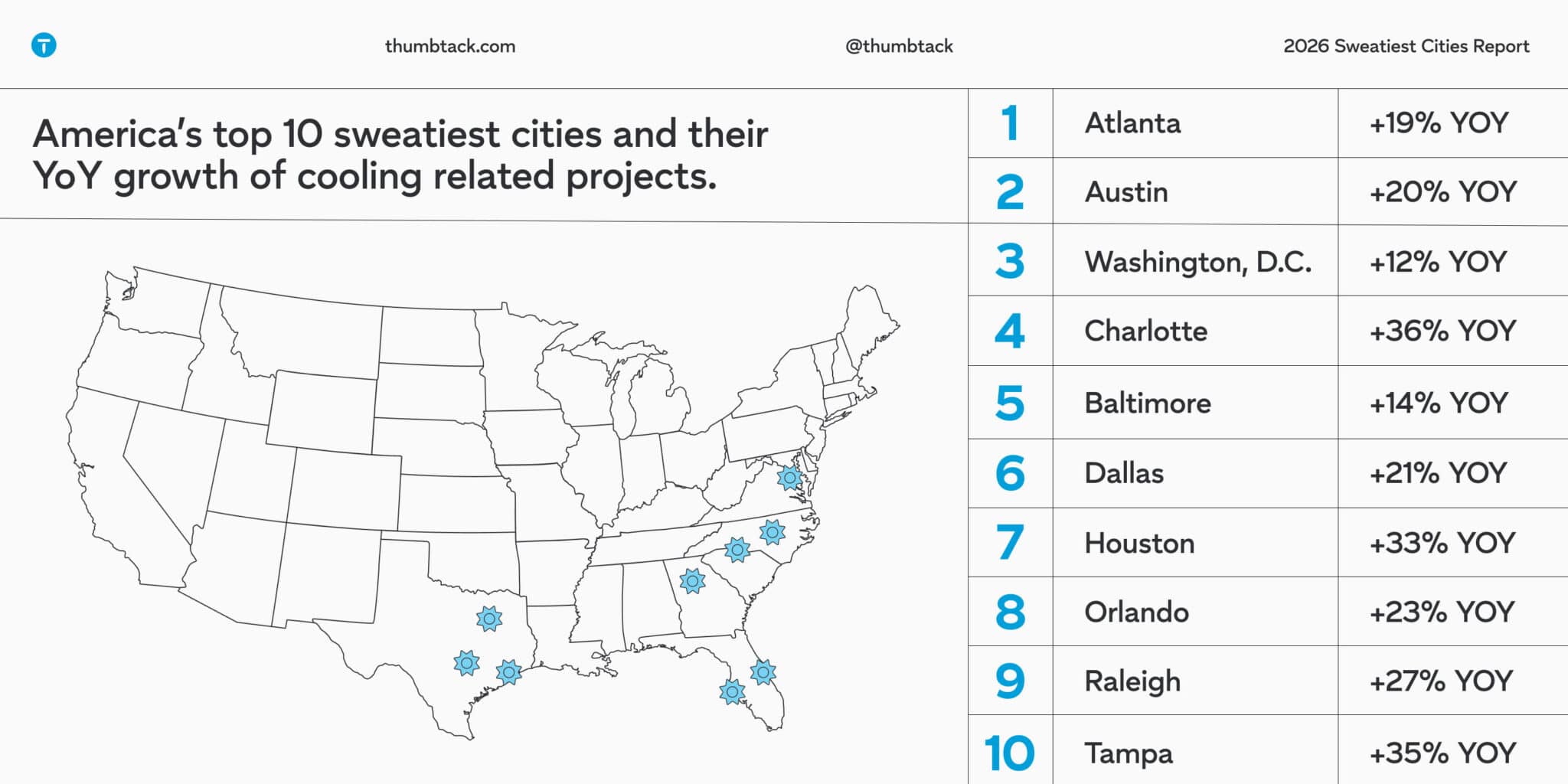
For the third year in a row, Thumbtack is revealing its list of America’s Sweatiest Cities, based on millions of requests for home cooling projects across the country. From repairing overworked air conditioners to installing smart thermostats, homeowners are turning to local pros to beat the heat.
The 10 sweatiest cities in America
This year, nearly everyone is feeling the heat. As record-breaking temperatures swept much of the country during a late June through early July heat dome, demand for cooling-related home projects increased year over year in 38 of the 40 largest metropolitan areas we analyzed.
The Southeast and Texas continue to dominate this year’s list, with residents turning to cooling-related home services at some of the highest rates in the country. For the second year in a row, Atlanta claims the top spot after enduring a sweltering Fourth of July weekend, with heat index values topping 100 degrees. Austin ranks second, reaching its first 100-degree day of 2026 in early July. Rounding out the top three is Washington, D.C., where temperatures climbed to 102 degrees on July 4, breaking the city’s previous record in 1919 for the hottest Independence Day.
Several of the cities at the top of this year’s ranking also saw significant increases in demand for home cooling projects compared to last summer. Year over year, requests rose 36% in Charlotte, 35% in Tampa, 33% in Houston, and 27% in Raleigh–Durham.
Marlon Chambers, Thumbtack Pro Advisory Board member and Owner of Climate Control Systems is noticing this climbing demand: “The recent heat waves have absolutely driven a surge in HVAC service calls. When temperatures stay above 90°F for several days, systems run almost nonstop. That constant strain exposes weak components and especially older capacitors, dirty coils, and systems overdue for maintenance. We’ve seen a noticeable uptick in emergency no-cool calls, refrigerant issues, and systems freezing over because they simply can’t keep up with the extreme load. Heat waves also reveal underlying issues that have been building for years in most homes.”
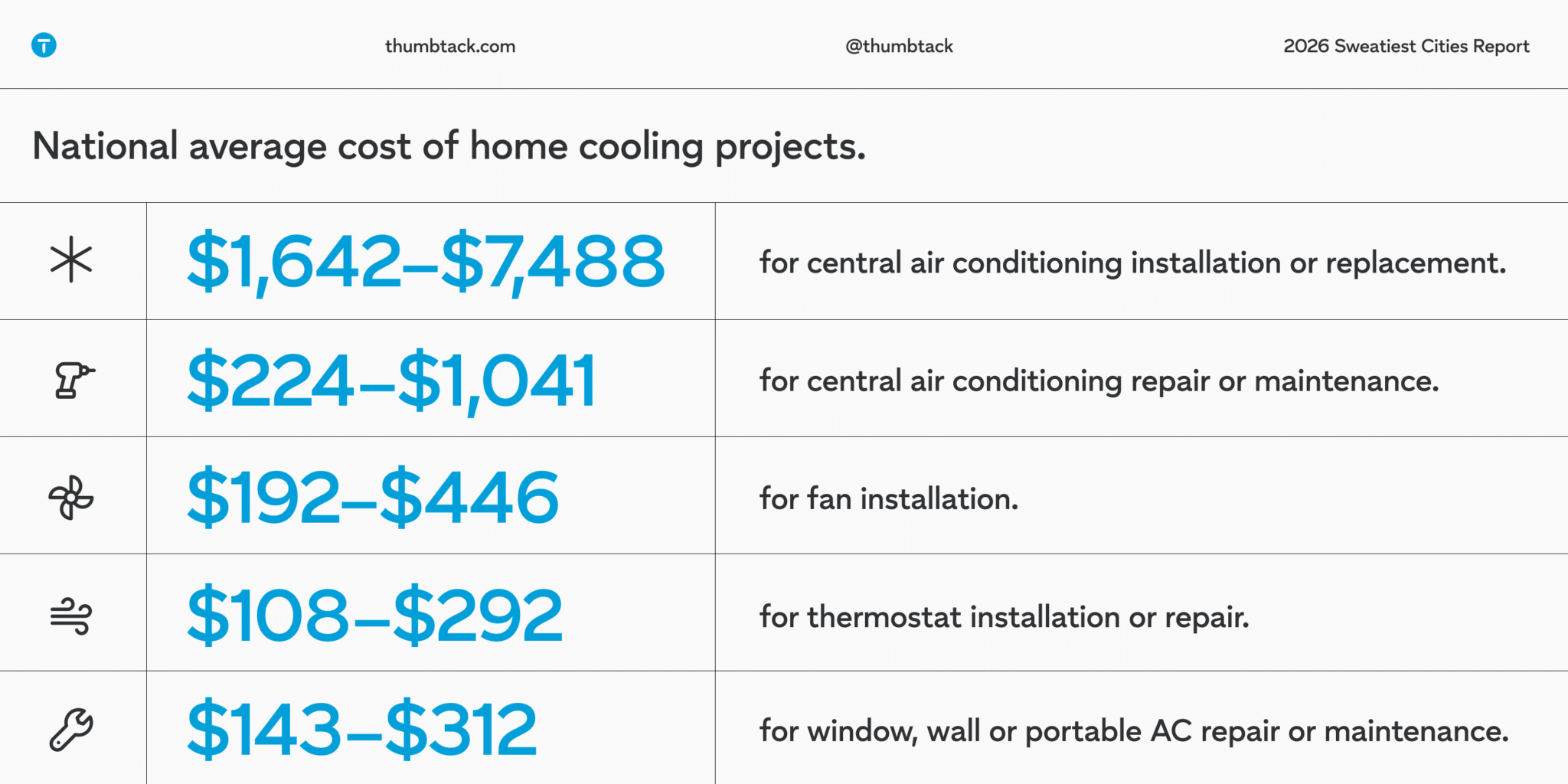 The cost of keeping your cool
As homeowners prepare for extreme summer temperatures to come, we looked at the national average cost of common home cooling projects, based on reports from our local pros:
Project costs vary depending on the scope of the work and the condition of an existing system. Staying ahead with routine HVAC maintenance and smaller efficiency upgrades can help homeowners avoid unexpected breakdowns, and potentially more expensive repairs, during the hottest days of the year.
Marlon shares the importance of regular HVAC maintenance:
“Preventative maintenance is one of the most cost effective things a homeowner can do. A proper tuneup can improve your system’s efficiency by 10–30%, lower monthly energy bills, and extend the lifespan of your HVAC system by several years- delaying costly replacements. It can also prevent major breakdowns, which often cost five to ten times more than routine maintenance, and keeps refrigerant levels stable to prevent compressor damage, one of the most expensive repairs in HVAC. Most emergency calls we respond to could have been avoided with regular maintenance to the HVAC system.”
Donald Hawkins Thumbtack Pro Advisory Board member and founder of Argo Home Services adds:
“We recommend having your HVAC system serviced at least twice per year. If you hear banging or grinding sounds from your HVAC unit, experience spikes in your power bill, and/or notice water pooling around the unit, search for a professional asap.”
The great American cooldown
Homeowners aren’t only repairing existing cooling systems. They’re also investing in major projects designed to make their homes and outdoor spaces more comfortable.
Requests for window, wall and portable AC repair or maintenance increased 96.2% year over year, while central AC installation or replacement rose 95.8%. Demand for thermostat installation and repair increased 25.8%, and fan installation grew 25.7%.
Outdoor cooling and leisure projects are also gaining momentum:
- Patio remodels and additions increased 139.4%
- Above-ground pool installations increased 138.1%
- Water feature repair and maintenance increased 35.9%
- Water feature installations increased 25.1%
- Swimming pool repair increased 22.2%
Together, these trends point to a broader shift: homeowners aren’t simply trying to cool down a room, they’re creating spaces where they can comfortably relax, entertain and recover from the summer heat.
How to keep your home cool without overheating your energy bill
A cooler home doesn’t always require running the AC at full blast, according to Donald:
“We definitely have seen many homeowners make the mistake of adjusting their thermostat far too low. Additionally, since kids are out of school during the summer and the home is being used more, filters tend to get dirtier faster and oftentimes are neglected. Combined, these issues overwork AC units and cause an increase in energy bills.”
A combination of regular maintenance, strategic upgrades and everyday habits can help improve comfort and efficiency.
- Maintain your HVAC system: Replace or clean filters regularly and schedule professional maintenance before peak summer heat puts the system under added strain.
- Use a programmable or smart thermostat: Adjusting the temperature when no one is home can help reduce unnecessary energy use.
- Seal air leaks: Weatherstripping and caulk can prevent cooled air from escaping around doors and windows.
- Block direct sunlight: Curtains, blinds, exterior shades and awnings can help reduce the amount of heat entering the home.
- Use ceiling fans strategically: Set fans to rotate counterclockwise in the summer and turn them off when leaving the room since fans cool people, not empty spaces.
- Limit heat-producing activities: Use ovens, dryers and dishwashers during cooler parts of the day whenever possible.
- Check insulation: Poor insulation can allow heat to enter through the roof and walls while making it harder for the home to retain cooled air.
Humid heat versus dry heat
Not all summer heat affects a home in the same way. The most effective cooling strategy depends partly on the local climate.
In hot, humid climates
Excess moisture can make a home feel warmer and force the cooling system to work harder. Marlon explains: “Humidity plays a major role in how your home feels, and how hard your HVAC system has to work. In humid climates, AC systems must remove both heat and moisture. High humidity makes the air feel warmer, causing systems to run longer. Oversized systems cool too fast and don’t remove enough moisture, leaving you feeling sticky and uncomfortable. Dehumidifiers, or variable-speed systems, are often recommended to better manage humidity and cooling loads.”
Homeowners may benefit from:
- Using a dehumidifier
- Keeping the HVAC system clean and properly maintained
- Checking for ventilation issues
- Considering a variable-speed or appropriately sized cooling system
- Sealing gaps that allow humid outdoor air to enter
In hot, dry climates
Homeowners in dry climates may want to focus on reducing direct sun exposure and adding moisture where appropriate. Options include:
- Exterior shades, awnings or shutters
- Reflective window treatments
- Strategic landscaping for shade
- Evaporative cooling systems where suitable
- Sealing and insulating the home to limit heat transfer
Marlon adds: “In dry climates your AC is mainly working to remove heat, not moisture, which means systems typically run more efficiently. In many cases, evaporative coolers, like swamp coolers, can be more effective because they add moisture to the air. Understanding the difference helps homeowners choose the right equipment and settings for their region and home.”
Don’t sweat it — Thumbtack can help
Whether you need an emergency AC repair, a more efficient thermostat or a complete cooling system upgrade, Thumbtack can help you understand what projects to tackle, what they may cost and which local pros to hire.
This summer, don’t wait until your home reaches its breaking point. A little preparation can help you stay comfortable, control energy costs and keep your cool — even in one of America’s sweatiest cities. Download the Thumbtack app today.
Methodology: We examined which of the top 40 metropolitan areas (according to the Nielsen DMA rankings) have the most requests for cooling-related projects including central air conditioning repair or maintenance, central air conditioning installation or replacement, window, wall, or portable AC repair or maintenance, fan installation, and thermostat installation or repair for May 1 -July 9 2026. We adjusted for population size by ranking cities based on the number of project requests per capita. The pricing ranges for these projects are based on national pricing estimates from projects on Thumbtack in 2026.