Air Movement, Commercial Equipment
Q-PAC’s Fan Array Testing Laboratory Receives World’s First AMCA 270 Lab Accreditation
Q-PAC’s accredited laboratory can now measure airflow and performance from 2,000 to 70,000 CFM, proving designs and accelerating product development.
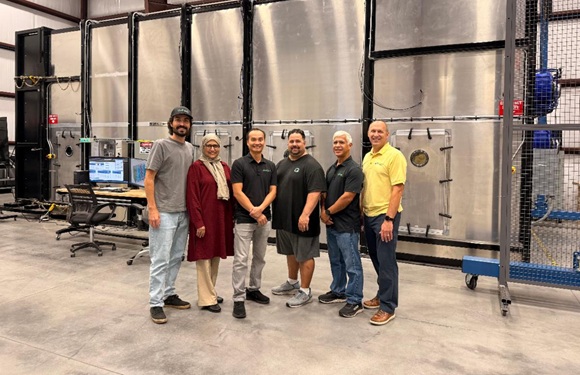
Q-PAC, a leader in the design and manufacturing of commercial HVAC fan systems, announced that its airflow tunnel testing laboratory is the first in the world to earn AMCA accreditation for fan array testing under AMCA 270 and AMCA 210/ASHRAE 51. AMCA 270 is the industry standard for testing multiple fans operating together, and the Q-PAC laboratory in Elkton, Florida is the first to be an operational facility delivering on this functionality.
The accreditation enables Q-PAC to conduct controlled, repeatable airflow and performance testing for fans and fan array configurations at a scale representative of real HVAC applications. Q-PAC can use the resulting detailed performance data to validate designs, optimize fan array configurations and support customer-specific equipment-development and application decisions.
“It is a significant industry milestone for the Q-PAC Lab to be awarded accreditation as the first AMCA-accredited laboratory for fan array testing in accordance with ANSI/AMCA Standard 270, Laboratory Methods of Aerodynamic Testing Fan Arrays for Rating.” said Nazme Mohsina Senior Director, Certification, Accreditation, and Documentation at AMCA International. “It demonstrates the team’s technical competence and leadership, establishing Q-PAC as a pioneer in advancing fan array testing and moving the industry forward.”
Q-PAC’s accredited laboratory can evaluate airflow from 2,000 to 70,000 CFM at up to positive or negative 12 inches water column static pressure. Its 12-foot-by-12-foot plenum accommodates both individual fans and larger fan array configurations, and was designed to exceed AMCA 270 requirements to support testing of multiple fans arranged together and establish reliable performance data for Q-PAC’s Multimotor Plenum Fan (MPF) platform.
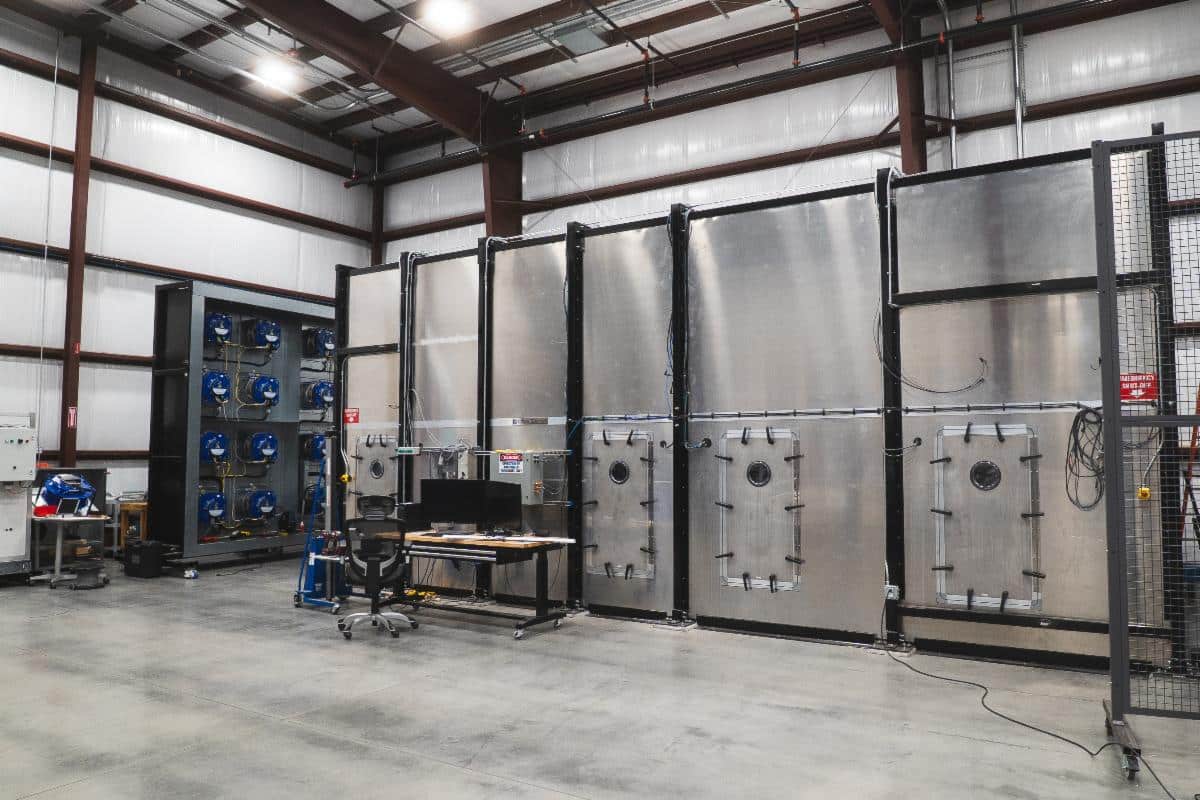 The laboratory captures and automatically logs key performance data, including airflow, static and total pressure, fan speed, input power, temperature and environmental conditions. Q-PAC’s custom tunnel-control software, automatically executes the test plan while still allowing manual control, and handles data collection and analysis — integrating PLC, LabVIEW, custom fan controls, automated dampers, and automated cone closures to improve consistency and minimize operator variation. This information allows Q-PAC to generate detailed and unique fan performance curves, compare configurations and assess the effects of changes to fan quantity, speed and controls before equipment reaches the field.
“We built this airflow tunnel to validate performance with the rigor it takes to turn ideas into knowledge, and knowledge into the next generation of fan technology,” said Ken Nguyen, Director of Q-PAC R&D, proudly.
For customer-specific applications, Q-PAC can use its accredited laboratory to perform the test-and-refine process internally, helping accelerate development and evaluation of new fan and fan array designs. Q-PAC engineers can use measured performance data to validate designs, troubleshoot issues before field deployment, and compare configurations across a broad range of operating conditions. This helps them determine the appropriate fan quantity, speed, and control strategy for a given system without relying entirely on extrapolated data, external estimates, rules of thumb, factors of safety to account for system effects, or test-facility scheduling.
The Q-PAC accredited facility uses a highly instrumented test environment, automated controls and a modular auxiliary-fan system to support testing arrangements aligned with AMCA 210 requirements, inclusive of 16 flow nozzles with automatic closures in order to provide airflow measurements across various operating conditions. The measurement system was designed to collect the parameters required by AMCA 270, including barometric pressure, rotational speed, input power, velocity pressure, static pressure, total pressure, temperature and nozzle pressure drop.
Developed in collaboration with Airflow Sciences Corporation, one of the most significant technical achievements of the project was bringing this wide operating range, high pressure capability, measuring precision, and testing flexibility together within a compact footprint. To achieve this, computer simulation played an important role throughout the design process. Structural simulation and analysis were used to ensure the tunnel could safely withstand its demanding pressure conditions, while airflow simulation was used to study how air moves through the tunnel and optimize the airflow path for accurate and consistent measurement. This allowed the design to be evaluated and refined virtually before construction began.
“Collaborating on this state-of-the-art AMCA 270 flow tunnel was a fantastic effort,” said Robert Mudry, president of Airflow Sciences Corporation in Livonia, Michigan. “Bringing this capability to life gives Q-PAC a powerful platform for advanced testing and product development, and Airflow Sciences is thrilled to have played a key role in making it a reality.”
To complete the accreditation process, Q-PAC conducted a tailored test of its multimotor plenum fan product in a two-by-two plug-fan configuration. The process included verification of AMCA 210 and AMCA 270 protocols, including flow-uniformity and measurement requirements, as well as remote and on-site witness testing. AMCA also independently tested Q-PAC Fans at its Chicago laboratory and verified that its findings were consistent with data generated in Q-PAC’s airflow tunnel.
Moving forward, Q-PAC will use the laboratory to expand its formal testing programs for individual fans and fan arrays, supporting customer and OEM engineering development as well as advanced product designs. The tunnel was designed to be modular and adaptable, enabling it to accommodate different fan types, configurations, applications, and future technologies as Q-PAC’s products continue to evolve. For example, the test section and auxiliary fan section can be swapped, while the control software is continuously evolving and expanding.
This combination of simulation, precision, automation, flexibility, and compact design makes the facility itself an important engineering achievement. It’s not simply equipment used to test another product; Q-PAC plans to further evolve the facility as a resource for validating product performance, accelerating development, exploring new ideas, and translating test data into meaningful product improvements. It also lays the groundwork and creates opportunities for deeper collaboration with customers and strategic partners in the years ahead, as the team continues to push the boundaries of possibility in the commercial HVAC space.
About Q-PAC
Q-PAC designs and manufactures advanced commercial HVAC fans. The flagship product, the Q-PAC Fan, is the industry’s first multimotor plenum fan (MPF). Designed as a smarter alternative to traditional fan arrays and blowers, the Q-PAC Fan is a fully integrated solution that offers built-in redundancy, fast installation, and compatibility with modern building automation systems. Q-PAC is committed to helping facility engineers and managers solve airflow challenges with ease. Learn more at www.q-pac.com