Heat Pumps
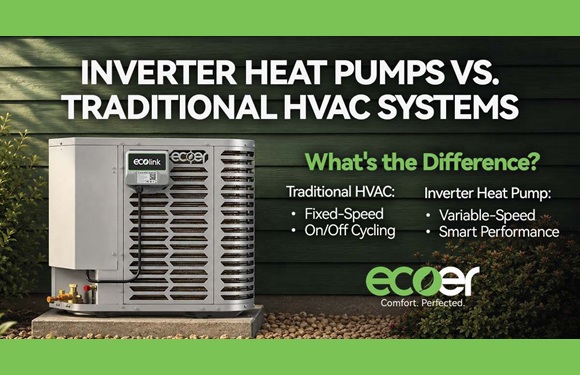
Inverter Heat Pumps vs Traditional HVAC Systems: What’s the Difference?
 Quick Answer
The biggest difference between an inverter heat pump and a traditional HVAC system is not simply energy efficiency—it’s how the system responds to real-world conditions.
Traditional HVAC systems operate by cycling on and off at full capacity. In contrast, inverter heat pumps continuously adjust compressor speed to match changing heating and cooling demand. This results in more consistent indoor comfort, improved humidity control, quieter operation, fewer compressor starts, and better long-term system performance.
At Ecoer, we believe the true value of inverter technology isn’t achieving higher peak efficiency—it’s delivering stable, verified performance every day homeowners actually live in their homes.
Table of Contents
- Why the HVAC Industry Is Moving Beyond Traditional Systems
- Traditional HVAC vs Inverter: Understanding the Core Difference
- Why Efficiency Isn’t the Biggest Advantage
- How Variable-Speed Technology Improves Everyday Comfort
- Why Partial-Load Performance Matters More Than Peak Ratings
- Installation Quality Matters More Than Ever
- The Future of HVAC Is Connected Intelligence
- The Ecoer Difference
- Frequently Asked Questions
- Conclusion
Why the HVAC Industry Is Moving Beyond Traditional Systems
For decades, residential HVAC systems were evaluated using a familiar set of metrics:
- Capacity
- Efficiency ratings
- Equipment size
- Initial cost
While these factors remain important, today’s homeowners expect much more than simply heating or cooling a house.
They expect:
- Consistent comfort throughout the day
- Better humidity control
- Lower operating costs
- Quieter operation
- Reliable long-term performance
Meeting these expectations requires more than increasing equipment capacity.
It requires HVAC systems that continuously adapt to changing conditions rather than repeatedly operating at full output.
That shift is one of the primary reasons inverter-driven heat pumps have become one of the fastest-growing technologies in residential HVAC.
But understanding inverter technology requires looking beyond higher SEER2 ratings.
The real difference lies in how the system behaves every minute it operates.
KEY INSIGHT
Ecoer Perspective
The biggest advantage of inverter technology isn’t higher efficiency.
It’s the ability to continuously adapt to changing conditions while maintaining stable, predictable comfort.
Traditional HVAC vs Inverter: Understanding the Core Difference
Every comfort system is built around one essential component:
The compressor.
The way the compressor responds to changing heating and cooling demand defines the difference between traditional HVAC equipment and inverter-driven systems.
Traditional HVAC Systems
Traditional single-stage equipment operates much like a standard light switch.
When indoor temperature moves outside the thermostat setting, the compressor starts at 100% capacity.
Once the desired temperature is reached, the compressor shuts off completely.
As indoor conditions change, the entire cycle repeats.
Although this approach effectively heats and cools a home, it creates repeated start-stop cycles throughout the day.
These frequent cycles contribute to:
- Larger indoor temperature swings
- More noticeable compressor noise
- Reduced humidity removal
- Increased mechanical stress
- Greater energy consumption during startup
Inverter Heat Pumps
An inverter heat pump approaches comfort differently.
Instead of operating only at full capacity or completely shutting off, an inverter-driven compressor continuously adjusts its operating speed based on the home’s actual heating or cooling demand.
During mild weather, the compressor may operate at only a fraction of its maximum capacity.
As outdoor conditions change or occupancy increases, compressor speed adjusts automatically to maintain comfort without unnecessary cycling.
Rather than treating heating and cooling as an “on-or-off” process, inverter technology creates a continuously balanced comfort system.
KEY INSIGHT
Traditional HVAC systems respond to temperature changes.
Inverter systems respond to comfort demand.
That distinction fundamentally changes how the entire system performs.
Why Efficiency Isn’t the Biggest Advantage
One of the most common misconceptions surrounding inverter technology is that its primary benefit is energy efficiency.
Higher efficiency is certainly an important advantage.
But it is not the most meaningful one.
The reality is that residential HVAC systems rarely operate under peak design conditions.
Most homes spend the majority of the year experiencing:
- Moderate outdoor temperatures
- Changing occupancy
- Variable solar gain
- Fluctuating indoor loads
In other words:Most HVAC systems spend most of their operating life at partial load—not maximum capacity.
This changes how performance should be evaluated.
Instead of asking:
“How efficient is the system at full output?”
Contractors should increasingly ask:
“How consistently does the system perform during the other 95% of its operating life?”
That is where inverter technology creates its greatest value.
KEY TAKEAWAY
Peak efficiency tells you how a system performs under ideal conditions.
Consistent performance tells you how homeowners actually experience comfort every day.
At Ecoer, we believe the future of HVAC should be measured by real-world performance—not laboratory ratings alone.
How Variable-Speed Technology Improves Everyday Comfort
The benefits of inverter technology extend far beyond lower utility bills.
Variable-speed operation influences nearly every aspect of residential comfort.
Instead of repeatedly starting and stopping throughout the day, inverter-driven systems continuously adjust capacity to maintain stable indoor conditions.
This allows contractors to deliver systems that perform more predictably over time while helping homeowners experience a higher level of everyday comfort.
The most significant advantages include:
- More precise load matching
- Better temperature stability
- Superior humidity management
- Quieter operation
- Reduced compressor cycling
- Longer component life
- Improved long-term reliability
These benefits are interconnected.
Together, they represent a different philosophy of HVAC design:
Rather than maximizing output,
modern inverter systems optimize performance continuously.
KEY INSIGHT
Efficiency saves energy.
Consistency builds comfort.
And over the life of a system, consistent performance is what homeowners remember.
How Variable-Speed Technology Improves Everyday Comfort
Variable-speed operation changes far more than compressor speed.
It changes how a home experiences comfort throughout the day.
Rather than repeatedly alternating between maximum output and complete shutdown, inverter-driven systems continuously adjust their capacity to match real-time demand. The result is a home that feels more stable—not because the system works harder, but because it works smarter.
For contractors, this means fewer comfort complaints, fewer unnecessary service calls, and greater confidence that the system is performing as designed.
Contractors looking for additional information on heat pump technology and energy efficiency can explore the ENERGY STAR® Air Source Heat Pumps resource.
More Precise Load Matching
Traditional HVAC systems are designed around peak load conditions.
The challenge is that homes rarely experience peak load.
Outdoor temperatures fluctuate. Occupancy changes. Solar gain shifts throughout the day. Internal heat loads rise and fall continuously.
An inverter heat pump responds to those changes automatically.
Instead of repeatedly delivering 100% output, it continuously adjusts compressor speed to closely match actual building demand.
The result is:
- More stable indoor temperatures
- Lower energy consumption
- Reduced equipment cycling
- Improved overall system efficiency
For contractors, this also reduces one of the biggest challenges in residential HVAC:
Systems performing differently in the real world than they did during equipment selection.
KEY INSIGHT
Equipment should adapt to the home—not force the home to adapt to the equipment.
More Consistent Indoor Comfort
Many homeowners don’t judge an HVAC system by its SEER2 rating.
They judge it by one simple question:
“Does my home feel comfortable?”
Traditional systems often allow indoor temperatures to drift several degrees before cycling back on.
Although this falls within thermostat tolerances, occupants frequently perceive these temperature swings as inconsistent comfort.
Variable-speed systems operate differently.
Because compressor output changes gradually rather than abruptly, indoor conditions remain much more stable throughout the day.
Instead of repeatedly overheating and overcooling a space, inverter systems maintain a narrower comfort band.
For homeowners, comfort becomes something they notice less—because the system quietly maintains it in the background.
KEY INSIGHT
Comfort isn’t created when equipment turns on.
It’s created by preventing discomfort from happening in the first place.
Better Humidity Control
Temperature is only one part of indoor comfort.
Humidity often has an even greater impact on how a home feels.
Traditional systems typically remove moisture during relatively short cooling cycles.
When those cycles end, dehumidification stops.
Inverter systems operate for longer periods at lower capacities, allowing the evaporator coil to remain active for extended periods.
This improves latent heat removal and creates a more balanced indoor environment.
This advantage becomes especially valuable in humid climates, where moisture control often determines whether occupants perceive a home as comfortable—even when the thermostat reads the correct temperature.
For contractors serving regions like Florida, Gulf Coast states, or other humid markets, improved humidity control frequently translates into higher homeowner satisfaction and fewer comfort-related callbacks.
KEY INSIGHT
Homeowners don’t experience temperature and humidity separately.
They experience comfort.
Quieter Operation
Noise is another area where inverter technology creates noticeable improvements.
Traditional fixed-speed systems generate significant startup noise each time the compressor begins operating.
Indoor airflow also changes abruptly as blower motors ramp to full speed.
Variable-speed systems reduce these sudden transitions.
By gradually increasing compressor and fan speed, inverter equipment operates much more smoothly.
Lower operating speeds during partial-load conditions also reduce overall sound levels both indoors and outdoors.
For homeowners, quieter equipment improves daily living.
For contractors, it removes another common source of post-installation complaints.
Reduced Equipment Stress
Every compressor startup introduces mechanical and electrical stress.
Over thousands of operating cycles, repeated hard starts contribute to component wear.
Variable-speed compressors reduce this stress by minimizing unnecessary cycling.
Rather than repeatedly accelerating from zero to maximum output, they spend much of their operating life operating steadily at lower speeds.
While proper installation and maintenance remain the most important contributors to long-term reliability, smoother compressor operation naturally reduces unnecessary strain on system components.
KEY INSIGHT
Reliability isn’t created by making equipment stronger.
It’s created by asking equipment to work more intelligently.
Installation Quality Matters More Than Ever
The advantages of inverter technology depend on one critical factor:
Proper installation.
Variable-speed systems are far more responsive than traditional equipment.
That responsiveness creates tremendous performance advantages—but also makes installation accuracy more important than ever.
Contractors should continue following manufacturer commissioning procedures, including:
- Airflow verification
- Refrigerant charge verification
- Communication wiring
- System sizing
- Startup commissioning
Small installation errors that may have had minimal impact on fixed-speed systems can significantly affect inverter system performance.
At Ecoer, we believe commissioning should not be viewed as the finish line.
It should establish the performance baseline for the entire life of the system.
KEY INSIGHT
Installation confirms that equipment starts correctly.
Performance verification confirms that it continues operating correctly.
From Commissioning to Performance Verification
This is where modern HVAC is evolving.
Historically, commissioning has been a one-time event.
A technician verifies airflow, refrigerant charge, electrical connections, and startup operation.
Once the system is running, the installation is considered complete.
But homeowners don’t live with their HVAC system for one day.
They live with it for years.
Ecoer believes the industry’s next evolution is moving from installation verification to continuous performance verification.
Connected HVAC technology makes this possible.
Instead of waiting until comfort complaints appear, contractors can gain greater visibility into how systems perform over time.
Performance trends, operating history, and diagnostic information create opportunities to identify developing issues earlier and respond more efficiently.
This approach helps contractors move from reactive service toward proactive system management.
KEY INSIGHT
The future of HVAC isn’t simply variable-speed equipment.
It’s equipment that continuously verifies its own performance.
Continue Building Your Expertise
Technology continues evolving, and contractor knowledge must evolve with it.
That’s why Ecoer created Hero Academy—our technical training platform designed specifically for HVAC professionals.
Hero Academy provides:
- Installation best practices
- Commissioning guidance
- Product education
- Diagnostic training
- Variable-speed system expertise
As inverter technology becomes the industry standard, ongoing education helps contractors improve installation consistency while delivering greater long-term customer confidence.
Traditional HVAC vs. Inverter Heat Pumps: Side-by-Side Comparison
Understanding the differences between traditional HVAC systems and inverter heat pumps goes beyond comparing specifications. The technologies represent two fundamentally different approaches to delivering comfort.
| Performance Characteristic | Traditional HVAC System | Inverter Heat Pump |
|---|---|---|
| Compressor Operation | Fixed-speed on/off cycling | Variable-speed modulation |
| Capacity Control | Full output or off | Continuously adjusts to demand |
| Part-Load Efficiency | Lower | Higher |
| Indoor Temperature Stability | Greater fluctuations | More consistent comfort |
| Humidity Control | Standard | Improved through longer runtime |
| Noise Levels | Noticeable startups and cycling | Quieter operation |
| Compressor Cycling | Frequent | Significantly reduced |
| Diagnostics | Basic fault codes | Advanced monitoring and performance visibility* |
| Long-Term Performance | Depends primarily on periodic service | Supports continuous performance verification* |
*Capabilities vary by manufacturer.
KEY TAKEAWAY
The biggest difference is not how much heating or cooling the equipment can produce.
It is how intelligently the system responds, adapts, and performs throughout its entire lifecycle.
Why Smart HVAC Is Becoming the New Standard
The evolution of HVAC is no longer defined solely by inverter compressors.
The next generation of systems is being shaped by something even more important:
Connected intelligence.
Historically, contractors relied on site visits and fault codes to understand how a system was performing.
Modern connected HVAC systems provide far greater visibility.
Instead of asking:
“Is the system running?”
Contractors can begin asking:
“Is the system performing exactly as designed?”
This shift changes the service model.
Rather than reacting to failures after homeowners notice them, connected systems help identify developing issues earlier, simplify diagnostics, and improve maintenance planning.
For contractors, better information leads to better decisions.
For homeowners, it creates greater confidence that their comfort system continues operating at its best long after installation.
KEY INSIGHT
The future of HVAC isn’t defined by smarter equipment alone.
It is defined by smarter information.
The Ecoer Difference
Many manufacturers build inverter heat pumps.
Ecoer builds inverter systems around one guiding philosophy:
Comfort should be measurable, verifiable, and sustainable—not simply promised.
That philosophy influences every stage of the homeowner and contractor experience.
Auto Charge
Proper refrigerant charge is one of the most important factors affecting inverter system performance.
Ecoer’s Auto Charge technology helps simplify the charging process during commissioning, reducing installation variability and helping contractors establish a stronger performance baseline from day one.
Connected Monitoring
Installation is only the beginning of a system’s lifecycle.
Ecoer’s connected platform provides greater visibility into system operation over time, allowing contractors to better understand how equipment performs under real-world conditions rather than relying solely on one-time startup measurements.
Smart Diagnostics
Instead of relying exclusively on traditional fault codes, Ecoer’s intelligent diagnostic capabilities help technicians identify performance trends, accelerate troubleshooting, and improve service efficiency.
The goal is not simply to identify failures.
It is to recognize developing issues before they become larger service events.
Comfort Defense Plus
Long-term comfort depends on long-term system performance.
Comfort Defense Plus extends connected monitoring beyond installation, supporting ongoing performance verification while giving contractors additional confidence that systems continue operating as intended.
Rather than treating service as a reactive event, Ecoer helps contractors deliver a more proactive ownership experience.
KEY INSIGHT
Technology creates value only when it helps contractors deliver better outcomes for homeowners.
That is the principle behind Comfort. Perfected.
Helping Contractors Build Better Businesses
Today’s contractors are expected to deliver far more than equipment.
Homeowners increasingly expect:
- Consistent comfort
- Lower operating costs
- Faster service
- Reliable long-term performance
Meeting those expectations requires more than selecting the right equipment.
It requires better installation practices, stronger technical knowledge, and greater visibility into system performance throughout its lifecycle.
Ecoer believes contractors create the greatest value when they move beyond selling HVAC equipment and become trusted comfort professionals.
The systems of the future will not simply heat and cool homes.
They will help contractors build stronger customer relationships through measurable performance, proactive service, and dependable comfort.
Frequently Asked Questions
What is the biggest difference between an inverter heat pump and a traditional HVAC system?
Is an inverter heat pump always more efficient?
Does inverter technology require different installation practices?
Why are connected diagnostics becoming more important?
How does Ecoer support contractors after installation?
Conclusion
The conversation around inverter technology often begins with energy efficiency.
It should end with something much more important:
Performance.
Compared with traditional HVAC systems, inverter heat pumps offer more than variable-speed operation.
They provide a fundamentally different approach to delivering comfort—one built on continuous adaptation, stable indoor conditions, improved humidity management, quieter operation, and greater long-term reliability.
As connected technologies continue to reshape residential HVAC, the industry’s greatest opportunity is no longer simply installing higher-efficiency equipment.
It is delivering systems that can verify performance, simplify service, and continue operating as intended throughout their entire lifecycle.
At Ecoer, that is how we define the future of comfort.
Not by making HVAC systems more complicated.
But by making them more intelligent, more predictable, and easier for contractors to deliver with confidence.
Comfort. Perfected.
Explore More from Ecoer
Whether you’re expanding your knowledge of inverter technology or looking for tools to improve installation quality, Ecoer provides resources designed to support contractors at every stage.
Continue your learning:
- Explore the Ecoer Hero Academy for technical training and commissioning guidance.
- Learn more about Ecoer inverter heat pump systems and our engineering philosophy.
- Discover how Comfort Defense Plus supports long-term performance through connected monitoring.
- Connect with the Ecoer team to discuss product selection, contractor support, or technical questions.